Sortomate
Makes it obvious what to do next.
A to-do list for tasks without deadlines.
Importance·Urgency·Effort
Get in touchSee it in action
On Android, Windows and the web. Screenshots show light and dark mode on Android.

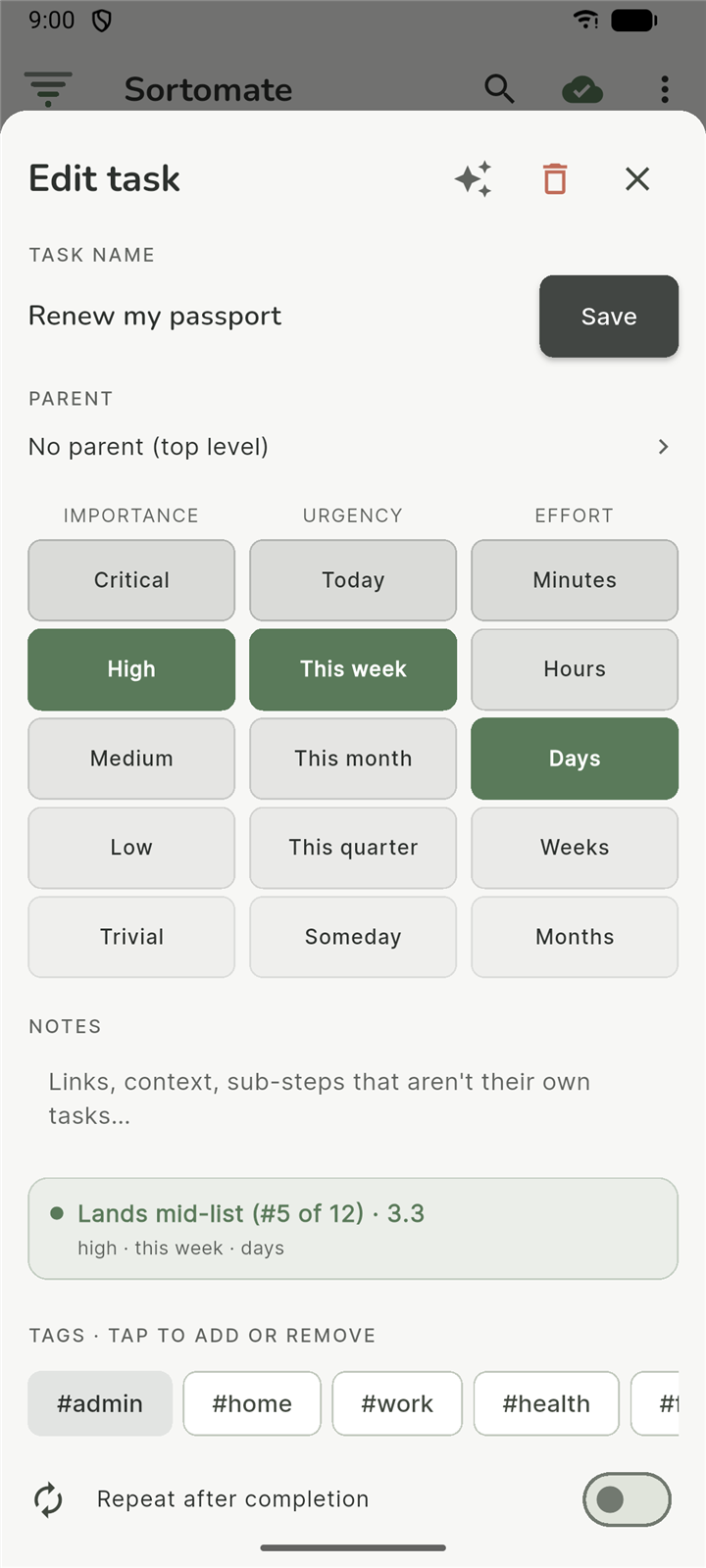

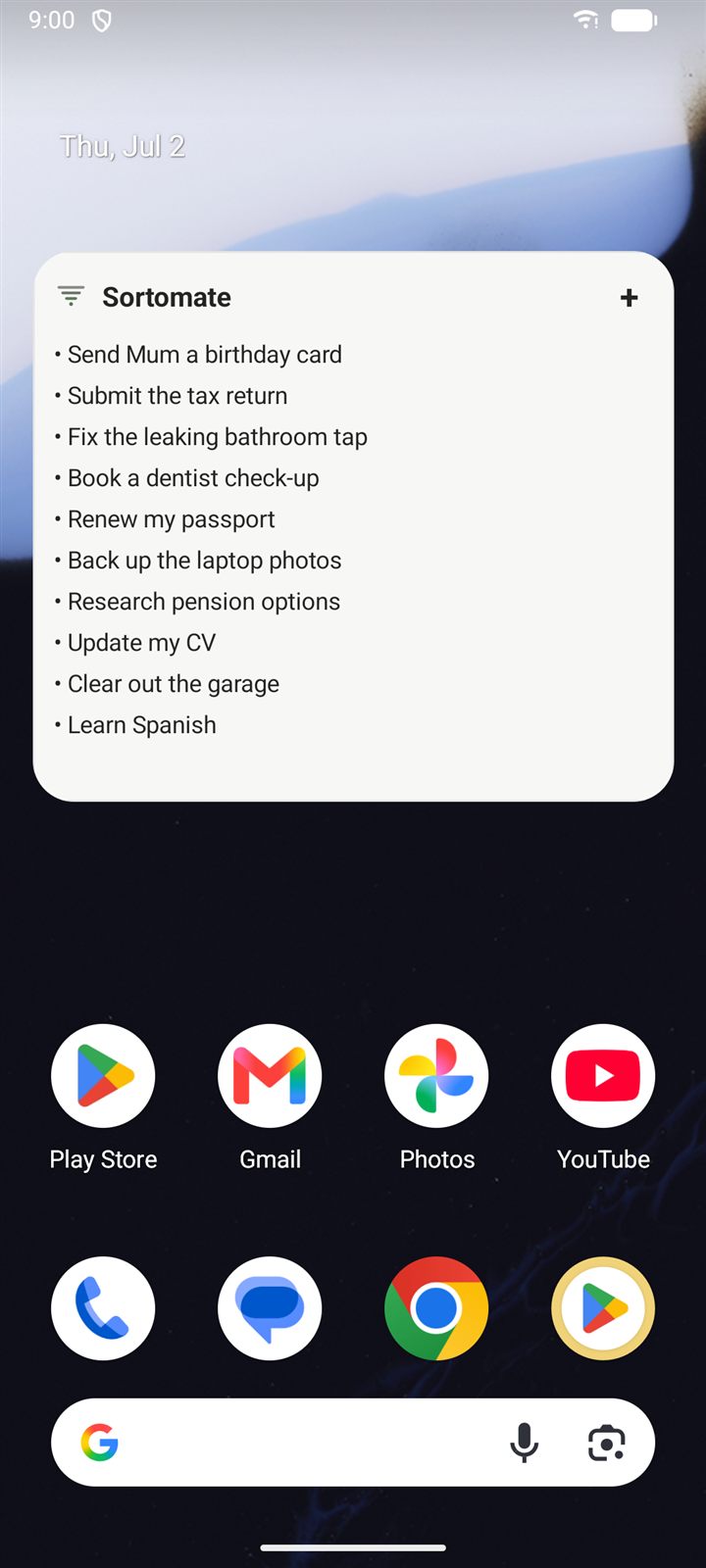
No invented due dates.
Urgency windows instead.
Most of your real work has no due date. Meetings have times and flights have dates, so they belong on a calendar with reminders. “Renew the passport” has neither. A tool that makes you invent a deadline hands you a wall of red you learn to ignore. Sortomate takes a different approach: score each task on importance, urgency and effort, let the formula sort, and trust the top of the list. It answers what do I do next, never who should do what: no assignees, no handoffs, just your own next action.
One open formula folds those three scores into a single number:
rating = 4 × (6 − importance)² ÷ (urgency × effort)
The score is deterministic. You can check it on a napkin. Tap any task’s score in the app and the formula appears, filled in with that task’s own numbers. Sortomate isn’t anti-AI, it’s anti-black-box: AI can help you break a task down, but it never gets to rank one for you.
Instead of due dates there are urgency windows: Today · This week · This month · This quarter · Someday. When a window passes, the task is stale, not overdue. You made no promise to anyone. It simply resurfaces, so you never have to remember to remember it.
When a date is real, not invented, pin it as a hard deadline. That is the exception you reach for on purpose, never a default Sortomate assumes for you.
Seeing the formula will never cost you anything.
Why I built this
I’ve kept structured to-do lists since at least 2005. The spreadsheet that survives from those years has a due-date column that stayed empty the whole time. Most of my work never had a real deadline.
In 2007 I bought Getting Things Done. It taught me to capture everything and define next actions. It never answered the daily question: of a hundred well-defined next actions, which one do I do right now?
So I went hunting for a tool that would rank them. Remember The Milk in 2008. Toodledo in 2010. DGT GTD on my phone in 2011, which I ran for the better part of a decade. Every one was a superb filing cabinet. Not one would look at my hundred next actions and say: do this one.
By 2008 I was automating the ranking myself, starting with an Excel sorting macro. The system eventually settled into three numbers per task, importance, urgency and effort, and one formula that folds them into a score. Sort by the score. For the first time, the top of the list was trustworthy. That exact system has run my work and personal life since 2021.
Through 2024 and 2025 the Android leg was Google Keep, and every task made a painful round trip: copied by hand into the spreadsheet, scored, sorted, copied back. So in early 2026, after a long search, I tried ClickUp, hoping to automate the spreadsheet and get it onto every platform I use. Trying to force ClickUp into the shape I wanted was clumsy, clunky and only partially worked. Out of frustration (and against AI advice based on cost!) I decided to build my own.
Sortomate is that spreadsheet, grown up. The same open, hand-checkable formula, finally automated and on every device I use. And it does the things a spreadsheet can’t: notices ageing tasks, resurfaces the forgotten, captures a task in seconds from any screen. So the top of the list stays worth trusting.
Adriaan, founder